
The Library · Perspective
Where this is going
A short, falsifiable set of expectations about the next few years, written down so it can be checked later, including the parts we expect to get wrong.
Predictions about AI are cheap because they are almost never written precisely enough to be wrong. This is an attempt at the opposite: a small number of expectations, stated so that someone could come back and mark them.
What we expect to hold
Capability will keep improving and will stop being the interesting variable. For most commercial applications the constraint is already not the model. It is evaluation, integration, trust, and the organisation's own clarity about what it wants. Those move on human timescales.
The scarce skill becomes specification. As producing an artefact gets cheaper, the value concentrates in knowing precisely what should be produced and being able to tell whether it was. This is an old pattern; it is what happened to every craft that got a power tool.
Verification becomes a first-class discipline. Where output is cheap and plausible, the ability to establish that something is correct becomes the bottleneck and therefore the profession. We expect this to be a larger shift than it currently looks.
Ambient use overtakes conversational use. Most valuable applications will not look like a chat window. They will be systems that do something quietly and correctly, where the intelligence is an implementation detail the user never addresses directly.
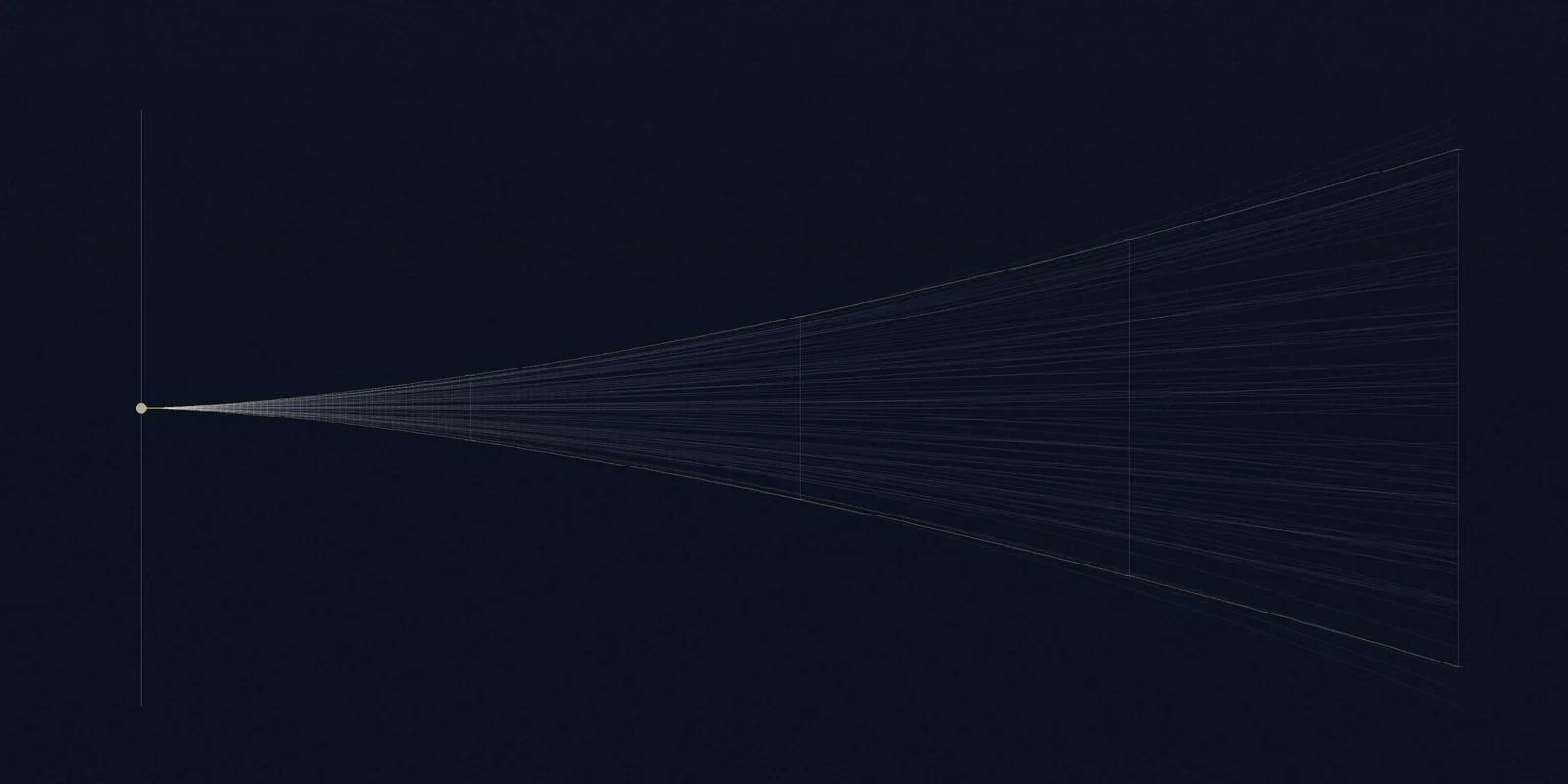
Trajectories from one present, spreading with time. The widening band is the honest claim; a single line through the middle of it would not be.
What we expect not to happen
Wholesale replacement of professions. The pattern we expect instead is the decomposition of jobs into tasks, the automation of some tasks, and the recomposition of the role around what is left, which is usually the accountable part. This is slower and less dramatic than replacement, and harder to sell as a headline.
Convergence on a single model or vendor. The economics point toward many models at different price and capability points, chosen per task. Architectures that assume one model are making an unnecessary bet.
A stable interface paradigm soon. Interaction design for these systems is genuinely unsolved. We expect several more rounds of it, and we expect the current conversational default to look as dated as early web skeuomorphism.
What we are least confident about
Honesty is more useful here than confidence.
We do not know how quickly the reliability gap closes for tasks requiring sustained multi-step correctness. Our expectation is "slower than the demonstrations suggest," and we hold it loosely, because it is the expectation most likely to be embarrassed by the next eighteen months.
We do not know how the economics settle. Inference costs have fallen steadily and the applications that become viable at each price point are hard to anticipate ahead of the fall.
We do not know what happens to entry-level professional work, and we think this is the most consequential open question of the set. If the first rungs of a career ladder are the tasks that automate first, the profession has a training problem that will not present for a decade and will be very hard to fix once it does.